
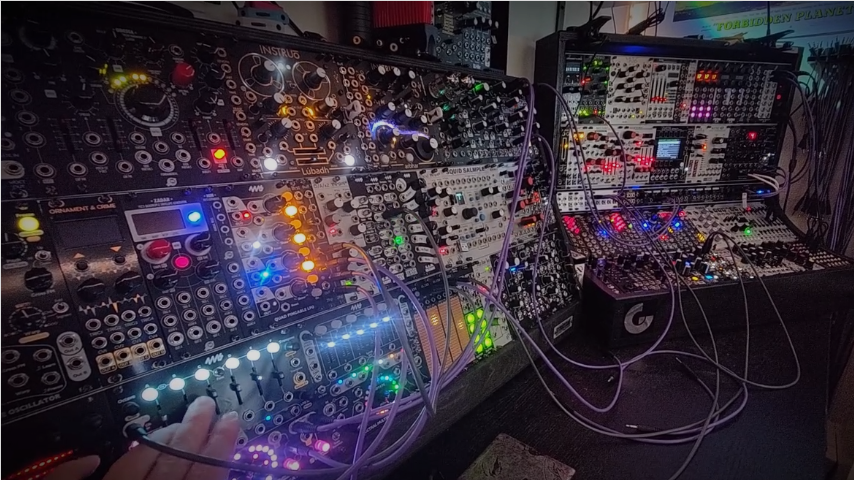
To the uninitiated, a modular synthesizer looks like a science experiment gone wrong. Or maybe a control panel from a spaceship from a 60’s sci-fi movie. It’s a wall of disparate boxes, knobs, and blinking lights. It has no keys. It has few presets. And most importantly, when you turn it on unpatched, it makes absolutely no sound. Each module is connected to power but not to each other. They seem cohesive but it actually takes leadership to connect them in meaningful ways.
It represents massive potential, but it has no voice. They are silent until connections are made.
I’ve spent years exploring this world of voltage and vibration, and while it’s a creative outlet, it’s also a masterclass in systems thinking. Starting from a blank canvas, I’m identifying disparate capabilities—oscillators, filters, logic gates—and determining how they should talk to one another (i.e. patched).
It turns out, the principles of patching a synthesizer are virtually identical to the principles of organizational leadership. It isn’t just about having the right components; it’s about how you connect them.
1. Listening & Capabilities: Know Your Modules
In modular synthesis, you generally need to know what each module can and cannot do—but you are also rewarded for imagination, playfulness, and trying new things. For example, while it is generally assumed you cannot force a filter to generate a tone, if you push the resonance and adjust the frequency, there are entirely new sounds to be had.
Professional leadership requires the same kind of deep listening and imagination. Before I can build a solution for a client or lead a project team, I have to understand the capabilities of the components involved—but I also have to know where those boundaries can be pushed.
What are the stated limitations of the client’s legacy system, and where might there be hidden potential? What is the unique strength of this specific team member that hasn’t been tapped yet? You don’t force a square peg into a round hole, but you do ask, “What if we used this tool in a way no one expected?” When you respect the intrinsic nature of the components but remain open to play, you find solutions that aren’t in the manual.
2. Alignment & Harmony: The Importance of the Clock
You can have the most expensive, powerful modules in the world, but if they aren’t talking to the same clock signal, you don’t have rhythm. You have chaos.
In the studio, a patch cable is a physical commitment. It connects two separate systems and says, “You are now working in lockstep.”
An organization is no different. It’s a complex circuit of departments—Treasury, Sales, Operations, IT. When they are siloed, they function, but they don’t groove. But when you create the connections—the communication lines and cross-functional workflows—the friction disappears.
The system hums. That’s operational harmony.
3. The Joy of Discovery: Creating Synergy
The real magic of modular synthesis isn’t just making individual modules work; it’s the emergent behavior that happens when they interact. Sometimes you patch a control signal from one system into another, and you discover a complex, evolving pattern that neither module could produce on its own. It’s the “happy accident” where 1 + 1 = 3.
This is the joy I find in building comprehensive solutions. It’s about synthesis in the truest sense—combining separate elements to form a coherent whole. When you understand the system deep down, you can architect interactions that create new value.
You can look at a standard Treasury problem and ask, “What if the output of this risk analysis automatically drove the parameters of that liquidity model?” You aren’t just managing tasks; you are designing an ecosystem where the components amplify each other. That isn’t just efficiency; it’s innovation.
The Signal Flow of Success
(skipping to 1:45 here will fast-track you to the most insightful part of this patch, impo)
Listen to that. It’s simple sequence, but elegant in its synchronicity.
This isn’t just noise; it’s a system working in tandem. It’s the result of understanding how the components of this organization work, listening, making the right connections, and exploring.
Listening, understanding, respecting the limits of our components (our clients and ourselves), and an eagerness to explore the possibilities. These are the hallmarks of exceptional service. The solutions are our song.