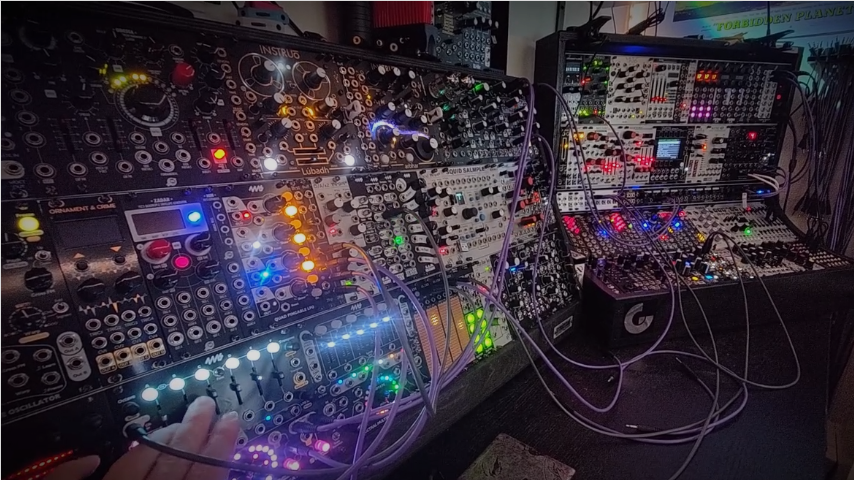

As someone who is passionate about music production and modular synthesis, I often encounter the same question—both personally and from people I teach: where do I even start? In modular, especially at the beginning, you’re staring at a panel full of knobs, cables, lights, and screens. It’s exciting, but also overwhelming. There’s no single right way to begin, no preset to load, no default path—just possibility. And that’s exactly what makes it uncomfortable.
Over time, I’ve found a simple starting point: the voice. What is this patch trying to say? What kind of sound—or idea—do I want to bring into existence? That question serves as an essential anchor. But the beautiful secret of modular is that knowing where to start doesn’t mean you know exactly where you will end up. In fact, if you grip the controls too tightly or over-engineer the signal path, you kill the very thing that makes the instrument feel alive.
Patching isn’t just a series of cold, purely calculated choices; it’s a delicate balance between intention and discovery. It’s about knowing enough to get off the ground, but not letting your technical knowledge constrain you to the point that you lose the joy of a happy accident. You patch to find a sweet spot. It is an act of rigorous experimentation and a pursuit of a thought process, but it is equally an embrace of informed risk. There is an ongoing anticipation that something completely unexpected, messy, and brilliant is waiting right around the corner, if you just leave enough room for it to happen. It’s in this space that we learn and grow.
I like to begin with something clean. A single tone. A basic melody. Just a raw oscillator giving you a baseline to work from. Once that core is there, you start shaping it—filtering out harsh frequencies or folding the waveform to add rich harmonics. But the real magic happens when you introduce movement. You map an LFO or a random voltage generator to a parameter, and suddenly, the patch starts talking back to you. It takes a sharp turn you didn’t plan, revealing a texture you couldn’t have engineered on purpose. By the time you add space with delay and reverb, or carve out room in the sonic frequency using sidechain compression, you aren’t just a pilot executing a static flight plan; you are in an active dialogue with the instrument. At the end of a session, you are left with something complex and layered. Every piece has a reason for being there, but some of the best elements arrived entirely by surprise.
The Parallel in Leadership and Collaboration
Our work, our projects, and how we lead teams are no different. From the outside, a successful project or a dynamic career might look complex, highly layered, and even a bit messy. But from the inside, the exact same framework applies to how we find our footing amidst chaos, break out of professional ruts, and build things of lasting value with other people.
When everything is possible—or when the status quo has locked us into a rigid, predictable routine—we have to approach our environments not as rigid systems to dominate, but as patches to guide. To do that effectively, especially when guiding others, we can break down the metaphor into a few core categories of practice:
1. Guiding Without Constraining (The Teacher’s Dilemma)
There is a unique phenomenon that happens when you sit down at a modular rack with a student. Your instinct as someone with experience is to give them a guiding hand—to map out the safe route, show them what inputs go where, and prevent them from making an error. But if you don’t actively try to stay out of their way, you rob them of the actual learning process. Because a student doesn’t carry the baggage of rigid, institutional knowledge, they aren’t bound by the traditional “rules” of what is supposed to work.
They will plug an audio-rate signal into a clock input just to see what happens. They take risks that experienced patchers might dismiss as technically incorrect. And yet, those un-rigid, unorthodox choices are precisely what lead to the most joyous, unexpected surprises. In leadership, the lesson is clear: our job isn’t to build a locked-down flight plan for our teams. True leadership means providing the foundational scaffolding—the baseline understanding of the system—and then deliberately stepping back. When we allow others the room to experiment without the fear of breaking the machine, we create a shared experience of discovering something genuine together.
2. Breaking the Status Quo (Rattling the Brain)
It is incredibly easy to fall into a professional rut. In work, this looks like defaulting to traditional ways of doing things simply because “that’s how the preset has always loaded.” We rely on our historical knowledge, but over time, that knowledge can paradoxically become our greatest constraint. It keeps us safe, but it also locks down our perspective and keeps us repeating the same patterns.
To stay mentally nimble, we have to find ways to intentionally rattle our brains out of the rut. In modular, if a patch feels stale, you introduce a wild card—a random voltage source or a strict limitation, like forcing yourself to use only one utility module. At work, we must introduce our own forms of disruption. This means actively seeking out the suggestions and perspectives of people outside our immediate circle, inviting dissenting ideas, and challenging long-held assumptions. Breaking the status quo requires a willingness to stop managing for absolute certainty and start managing for exploration.
3. Finding the Sweet Spots (Informed Risk and Intuition)
A “sweet spot” on an analog synthesizer is that precise, microscopic millimeter of a knob turn where the filter resonance perfectly interacts with the oscillator frequency. You can’t always calculate it mathematically on paper; you have to find it by turning the dial slowly, listening intently, and letting intuition take over. It requires a baseline of technical competence to get into the right neighborhood, but finding the peak experience requires feeling your way through.
In project management and team collaboration, sweet spots are those moments where individual strengths, clear communication, and timing align perfectly. You get there by knowing the technical execution inside and out, but remaining flexible enough to pivot when the landscape shifts. It is the practice of informed risk—knowing enough to establish the guardrails, but trusting your intuition, and your team’s capability, to pursue an unexpected opportunity when it flashes across the radar.
4. Tuning and Sidechaining the System (Intentional Space)
The best modular performances don’t feature every single module blaring at maximum volume simultaneously. That just creates a wall of incoherent noise. Instead, it relies on sidechaining—literally ducking the volume of one element to carve out physical and rhythmic room for another to breathe. It’s an exercise in deliberate omission.
In a corporate or collaborative environment, managing the “mix” is the ultimate test of prioritization. A healthy culture requires knowing when to push your perspective forward and when to intentionally step aside so someone else’s voice can cut through the noise. It means recognizing that a team’s productivity and creativity don’t improve by adding more meetings, more processes, or more complexity. True efficiency comes from carving out intentional space—space for deep work, space for reflection, and space for people to cross-pollinate ideas naturally.
Recognizing these operational parallels forces us to look past superficial structural charts and see our working dynamics for what they truly are: living, shifting, multi-variable environments. When we stop managing for total predictability and lean instead into the mechanics of discovery, the questions we ask ourselves change entirely. We have to look at our day-to-day work and wonder: Are we holding the cables too tightly, or are we giving our teams the structural freedom to surprise us with an unorthodox solution? What institutional “preset” are we running on autopilot right now that actually needs to be torn down and patched from scratch? Where are we over-engineering a process to eliminate risk, at the cost of completely eliminating discovery, agility, and joy? Have we carved out enough space in our team’s mix for a happy accident to actually occur?
You don’t need to have every variable of the final outcome figured out from the very beginning. You just need a solid baseline, a willingness to take an informed risk, and the openness to listen to the beautiful, unexpected directions the creation takes you as you go.